Published: 2026-11-07
Furnace Won’t Ignite? What to Check Before You Call
Many “no heat” calls come down to a setting, a switch, or a clogged filter. Here’s how to check the simple things safely—and when to stop and call a professional.
When a Utah cold snap hits, a furnace that won’t light is more than an inconvenience. Before you schedule a service call, a few quick checks can often get the heat back on—or at least tell you what’s wrong. None of these steps require tools or removing anything but the furnace’s front door.
How Your Furnace Lights
A modern gas furnace doesn’t light the moment the thermostat calls for heat. It runs through a safety sequence first: the inducer fan starts, a pressure switch confirms the vent is clear, the igniter heats up, the gas valve opens, and a flame sensor confirms there’s a flame. If any step fails, the control board shuts the gas off and tries again. After several failed attempts, many furnaces go into a temporary lockout.
That’s why a furnace that “won’t ignite” is often protecting itself. The checks below look for the most common reasons a safety step fails. For a closer look at each step, see what happens when your thermostat calls for heat.
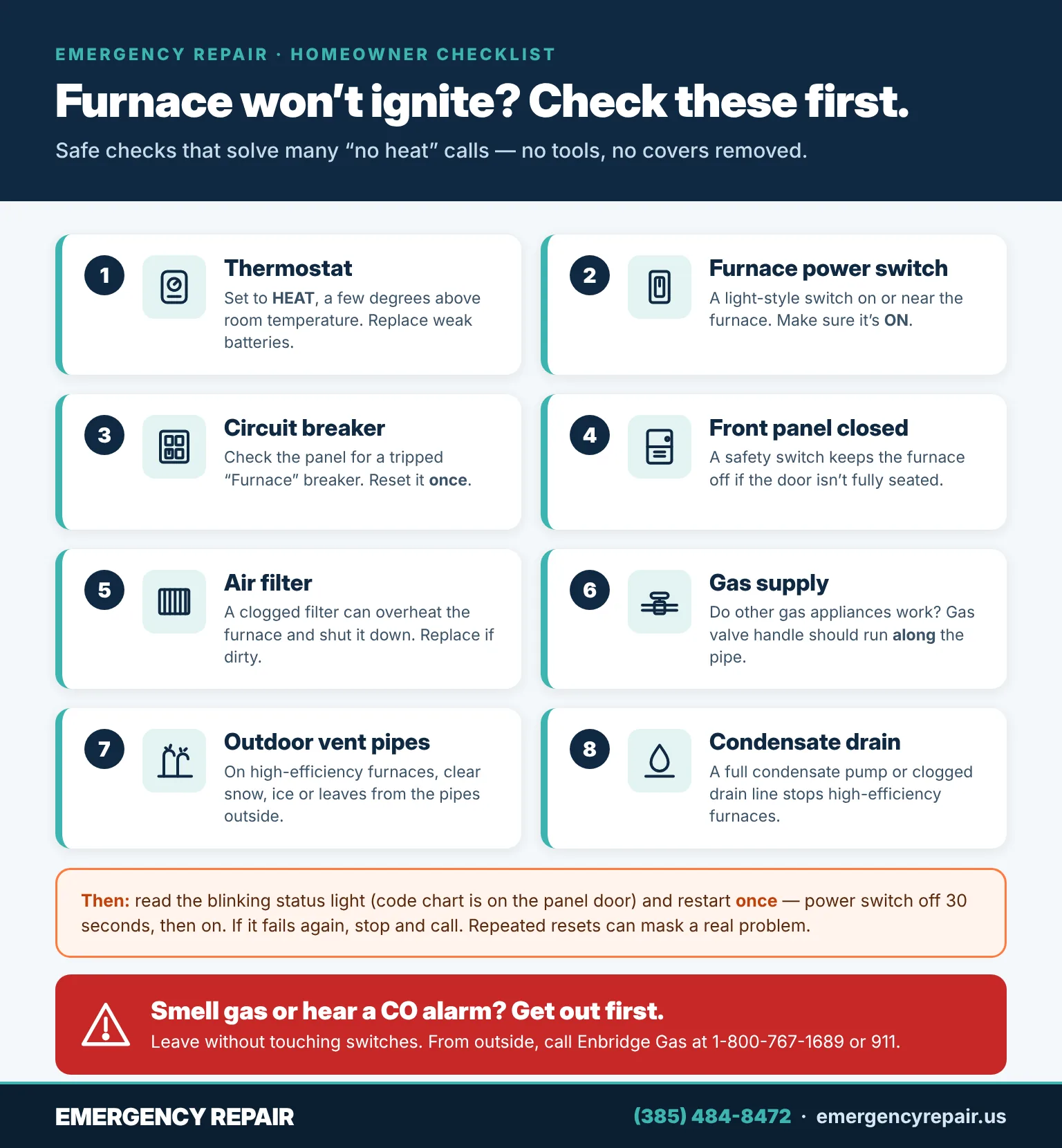
8 Things to Check Before You Call
1. Thermostat settings and batteries
Make sure the thermostat is set to HEAT (not COOL or OFF) and the set temperature is a few degrees above the current room temperature. If the display is blank or dim, replace the batteries. Smart thermostats can also follow a schedule or an “away” mode, so check that a schedule isn’t holding the temperature down.
2. The furnace power switch
Most furnaces have a service switch that looks like an ordinary light switch, mounted on the furnace or on a nearby wall or ceiling joist. It’s easy to flip off by mistake when someone is looking for a light. Make sure it’s ON.
3. The circuit breaker
Check your electrical panel for a tripped breaker labeled “Furnace” or “FAU.” A tripped breaker sits between ON and OFF. Switch it fully OFF, then back ON—once. If it trips again, leave it off and call; a breaker that keeps tripping points to an electrical problem.
4. The front panel
Furnaces have a door safety switch that keeps the system off when the blower door isn’t fully in place. If the panel was recently removed (for example, to change the filter), make sure it’s seated firmly and latched.
5. The air filter
A badly clogged filter restricts airflow. The heat exchanger then gets too hot, a high-limit safety switch opens, and the burners shut down—sometimes after only a few minutes of heating. If the filter is gray and caked with dust, replace it with the same size (printed on the filter frame).
6. The gas supply
Check whether your other gas appliances—stove, water heater, fireplace—are working. If none of them are, the problem may be with the gas service, and you should contact the gas utility. You can also look at the gas shutoff valve on the pipe leading to the furnace: on most valves, the handle runs along the pipe when it’s open. If it’s turned across the pipe and you don’t know why, don’t turn it on yourself—it may have been shut off for a reason. Call us.
7. The outdoor vent and intake pipes
High-efficiency furnaces usually have two white plastic pipes that exit through a wall or the roof. Heavy snow, drifting, ice buildup, leaves, or even a bird’s nest can block them. When that happens, the pressure switch won’t allow ignition. Gently clear snow and debris from around the pipe openings. Don’t push anything into the pipes.
8. The condensate drain or pump
High-efficiency furnaces produce water as they run. That water drains through a small hose, often into a condensate pump with a little reservoir. If the line is clogged, frozen, or the pump has failed, a safety switch stops the furnace. Look for water on the floor around the furnace or a pump reservoir that’s full.
Read the Status Light, Then Restart Once
Most furnaces have a small window in the lower door where you can see a blinking LED. The number of blinks is a code, and the code chart is usually printed on a label on the inside or back of the door. Write the code down; it helps us diagnose the problem faster.
After you’ve checked everything above, you can try one restart:
- Turn the furnace power switch off and wait about 30 seconds.
- Turn it back on and let the furnace go through its startup sequence. This can take a few minutes.
If the furnace still won’t light—or lights and shuts off again—stop there. Resetting it over and over doesn’t fix the cause and can hide a problem that needs attention.
What Not to Do
- Don’t bypass, tape, or jump any switch on the furnace. Those switches are there to prevent fires and carbon monoxide problems.
- Don’t touch the igniter. Many igniters are fragile and can crack from a light touch or from the oils on your skin.
- Don’t try to light a modern furnace with a match or lighter. On older furnaces with a standing pilot light, follow only the relighting instructions printed on the furnace label—and call if the pilot won’t stay lit.
- Don’t remove internal covers or open the gas valve if you’re unsure why it was closed.
When to Call a Professional
It’s time to call if:
- You’ve completed the checks and the furnace still won’t ignite.
- The furnace lights briefly, then shuts off repeatedly.
- The breaker trips again after you reset it.
- You hear loud bangs, see scorch marks, or notice a burning smell that doesn’t go away.
- The status light shows a code for the flame sensor, igniter, pressure switch, or gas valve.
Those are usually signs of a worn igniter, a dirty flame sensor, a failing pressure switch, a control board problem, or a venting issue—repairs that need proper testing. Learn more about our residential furnace repair and emergency HVAC service.
Prevent the Next No-Heat Call
Most ignition problems build up slowly. A fall tune-up cleans the flame sensor, tests the igniter and safety switches, checks the venting and condensate drain, and catches worn parts before the first cold night. See our maintenance plans, which cover both your furnace and air conditioner.
Frequently Asked Questions
Why does my furnace click but not light?
The clicking is usually the control board or relays trying to start the sequence. If there’s no flame, the cause may be a failed igniter, a pressure switch that isn’t closing (often a blocked vent or drain), or a gas supply problem. Check the status light code.
My furnace lights, then shuts off after a few seconds. Why?
A common cause is a dirty flame sensor that can’t confirm the flame, so the furnace shuts the gas off for safety. A clogged filter or blocked vent can also cause short cycling. A technician can clean or test the sensor.
How long does a furnace lockout last?
It varies by model. Many reset automatically after about an hour, while turning the power off and on clears the lockout right away. If it locks out again, the underlying problem still needs to be found.
Is it safe to keep resetting my furnace?
No. One restart after the basic checks is reasonable. Repeated resets can allow unburned gas to build up or hide a venting problem. If one restart doesn’t work, call for service.
No Heat? We Can Help.
If you’ve worked through this checklist and your furnace still won’t ignite, Emergency Repair can diagnose the problem and explain your options before any work begins. We respond the same day.
We serve Sandy, Salt Lake City, Draper, and communities throughout the Wasatch Front.
Emergency Repair
Your Comfort Is Our Business.