Updated: 2026-10-05
What Happens When You Turn Your Thermostat to Heat?
Understanding Your Furnace Startup Sequence
As temperatures begin to drop across Utah, many homeowners will soon make a familiar seasonal change: switching the thermostat from COOL to HEAT.
You set the thermostat a few degrees above the temperature in your home and wait. A short time later, you expect warm air to begin coming from the vents.
It seems simple.
But behind the scenes, quite a bit has to happen before that warm air reaches your home.
A modern gas furnace doesn't simply receive a signal from the thermostat and immediately open the gas valve and light the burners. Instead, it normally follows a carefully controlled sequence of operation designed to start the heating system safely.
Understanding that sequence can help homeowners recognize what is normal, what may indicate a problem, and why a furnace sometimes refuses to start.
Your Thermostat Starts the Conversation
One of the most important things to understand about your thermostat is that the thermostat doesn't actually produce heat.
Think of it as the messenger between you and your heating system.
When you switch the thermostat to HEAT and set the desired temperature above the current room temperature, the thermostat sends a call for heat to the furnace.
From that point forward, the furnace takes over.
Before allowing the burners to operate, however, the furnace needs to make sure several conditions are correct.
That's where the furnace startup sequence begins.
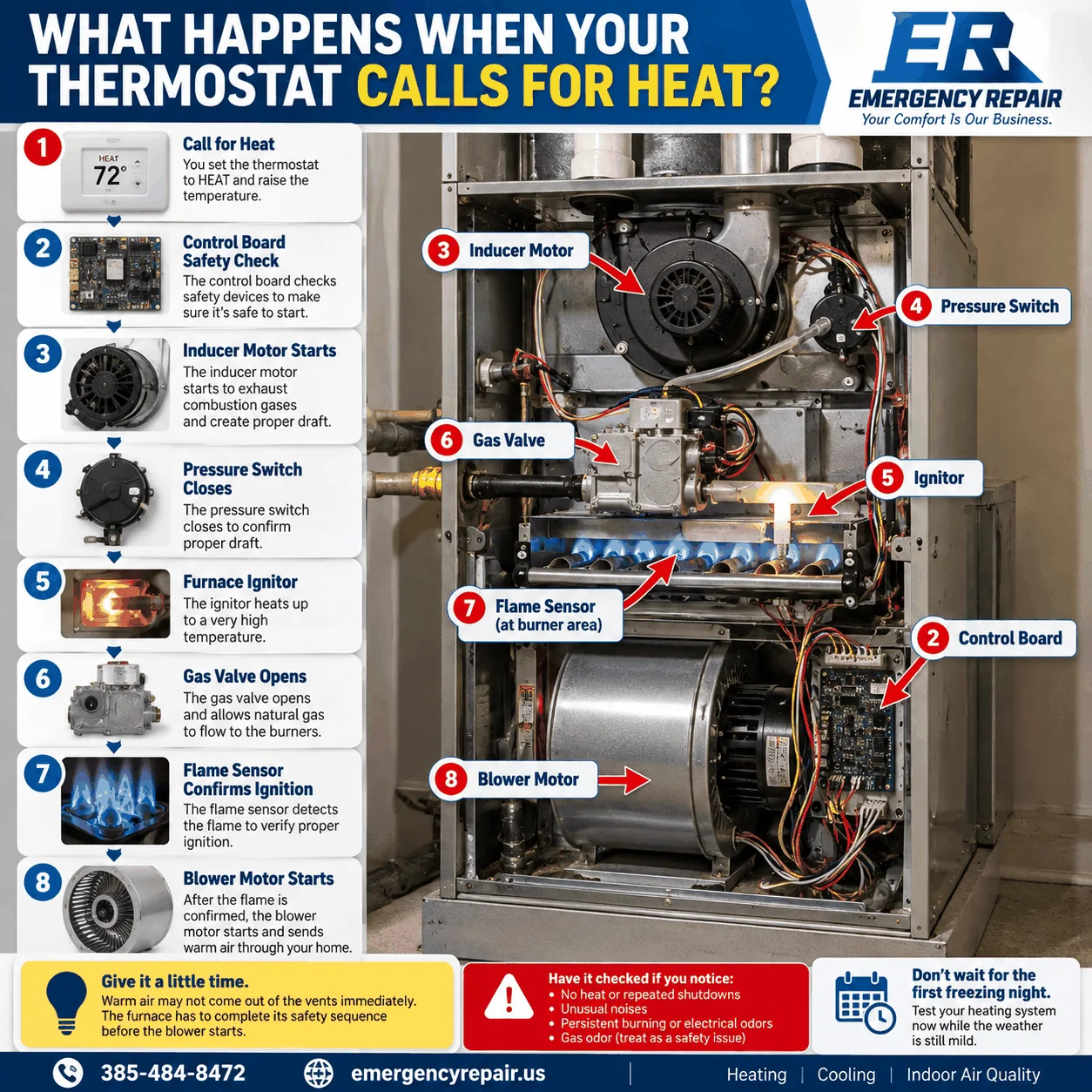
The 8 Steps of a Typical Gas Furnace Startup Sequence
1. The Thermostat Calls for Heat
Suppose the temperature in your home is 68°F and you set your thermostat to 72°F.
The thermostat recognizes that the room temperature is below your requested temperature and sends a signal to the furnace requesting heat.
This is commonly called a call for heat.
That signal doesn't mean the burners should immediately ignite. It tells the furnace control system to begin its startup sequence.
2. The Furnace Control Board Begins the Sequence
The furnace's electronic control board acts much like the coordinator of the heating system.
After receiving the call for heat, the control system begins managing the startup process and monitoring the furnace's safety and operating circuits.
If the furnace detects a condition that prevents safe operation, it may stop the sequence rather than continue toward ignition.
This is one reason a furnace that "won't turn on" isn't necessarily doing nothing. It may have started its sequence but failed to satisfy one of the conditions required to continue.
3. The Inducer Motor Starts
One of the first components you may hear is the inducer motor.
The inducer helps establish the proper flow of combustion gases through the furnace and toward the venting system.
If you're standing near the furnace when a heating cycle begins, you may hear a small motor start before you hear the burners ignite. That can be completely normal.
The furnace is preparing for combustion before allowing gas to flow to the burners.
4. The Pressure Switch Confirms Proper Draft
After the inducer begins operating, the furnace needs confirmation that the expected draft condition has been established.
This is where the pressure switch becomes part of the sequence.
When the required pressure condition is satisfied, the control system receives confirmation that it can proceed to the next stage.
If that confirmation doesn't occur, the furnace generally should not proceed with normal ignition.
5. The Furnace Igniter Activates
Once the required conditions have been satisfied, the furnace prepares to ignite the burners.
Many modern furnaces use a hot-surface igniter.
The igniter heats to a very high temperature and may glow bright orange during operation.
This component replaces the continuously burning pilot light found in many older furnace designs.
Once the igniter is ready, the furnace can proceed to the next step.
6. The Gas Valve Opens and the Burners Ignite
The control board then allows the gas valve to open.
Natural gas flows to the burner assembly and is ignited.
At this point, you may hear the burners light and, depending on the furnace design, may be able to observe the burner flame through an appropriate viewing area.
But the furnace still isn't finished checking the heating cycle. It needs confirmation that ignition actually occurred.
7. The Flame Sensor Confirms Ignition
The flame sensor has an important safety function.
Its job is to verify that a flame is actually present after the gas valve has opened.
If the furnace does not confirm the expected flame, the control system should stop the flow of gas rather than allow unburned gas to continue entering the burner area.
This is one reason some furnace problems can appear as: "The burners light, and then shut off again shortly afterward."
Something in the sequence may not be receiving the confirmation the furnace expects. Determining exactly why requires proper diagnosis.
8. The Blower Motor Starts
Even after the burners ignite successfully, you may notice that warm air doesn't immediately come out of your vents.
That's often normal.
The furnace typically allows time for the heat exchanger and surrounding furnace components to warm before starting the blower motor.
Once the appropriate conditions are reached, the blower begins moving air through the furnace and distributing heated air through the ductwork and into your home.
Now you finally feel warm air coming from the registers.
Why Doesn't Warm Air Come Out Immediately?
This is a common question.
A homeowner raises the thermostat, waits several seconds, feels nothing coming from the vents, and immediately wonders whether something is wrong.
But your furnace isn't supposed to behave like a light switch.
There can be a normal delay while the furnace progresses through its startup sequence and begins warming before the blower starts circulating air.
What deserves more attention is when the sequence never completes, the furnace repeatedly attempts to start, the burners repeatedly shut down, or the blower runs without the home receiving adequate heat.
Before the First Cold Utah Night, Test Your Furnace
One of the simplest things a homeowner can do is also one of the most useful:
Don't wait until the first freezing night of the season to discover that your furnace isn't working.
While the weather is still relatively mild, turn your heating system on and let it complete a normal heating cycle.
Before doing so, consider a few basic checks:
- Check the furnace filter. A dirty filter can restrict airflow and affect system performance.
- Set the thermostat to HEAT.
- Raise the thermostat setting a few degrees above the current room temperature. This gives the system a clear call for heat.
- Make sure the furnace power switch is ON.
- Make sure supply registers and return-air openings aren't blocked.
- If your gas supply was intentionally shut off for the summer, make sure service has been properly restored before attempting to operate the furnace.
Then give the furnace enough time to work through its normal startup sequence.
What If the Furnace Starts and Then Shuts Down?
This is where understanding the sequence of operation becomes particularly helpful.
If the furnace begins operating but doesn't complete the heating cycle, the point at which it stops can provide useful information to a trained HVAC technician.
You might observe that:
- The thermostat calls for heat, but nothing else appears to happen.
- The inducer motor starts, but ignition never occurs.
- The igniter operates, but the burners don't light.
- The burners ignite but shut off shortly afterward.
- The burners remain on, but the blower doesn't start as expected.
- The blower runs, but the home isn't getting sufficiently warm.
These observations can be helpful when describing the problem to your HVAC technician.
Warning Signs You Shouldn't Ignore
A furnace deserves professional attention when you notice behavior such as:
- No heat or repeated failed startup attempts
- Frequent or repeated shutdowns
- Unusual banging, grinding, rattling, or other new noises
- Persistent electrical or burning odors
- A blower that isn't operating normally
- Heating performance that suddenly changes
- A system that repeatedly attempts to ignite without completing a normal cycle
A technician can evaluate the complete sequence rather than simply replacing the component that appears to be involved.
That's important because one failed step can sometimes be caused by a problem somewhere else in the system.
A Special Word About Gas Safety
If You Smell Gas
Do not attempt to start, restart, or troubleshoot the furnace.
Do not remain in the area trying to determine which furnace component is responsible.
Leave the area and contact your gas utility or emergency services from a safe location.
Why Technicians Pay Attention to the Sequence of Operation
When an HVAC technician diagnoses a furnace, understanding the sequence of operation provides a logical path through the system.
Instead of simply asking, "Which part should I replace?" a better diagnostic question is:
Where did the normal sequence stop — and why?
If the thermostat called for heat, what happened next?
- Did the inducer start?
- Was the required pressure condition established?
- Did the igniter operate?
- Did the gas valve receive the appropriate command?
- Did ignition occur?
- Was the flame confirmed?
- Did the blower start?
Following the sequence helps technicians diagnose the cause of the failure, rather than simply guessing at parts.
And that is one of the differences between troubleshooting and parts-changing.
Don't Wait for the First Freezing Night
Utah's fall weather can change quickly.
Your furnace may have been sitting unused for several months, and the worst time to discover a heating problem is the evening when temperatures suddenly drop and many other homeowners are discovering problems at the same time.
Give your heating system a test run before you truly need it.
Listen to the startup. Give it time to complete its sequence. Make sure warm air eventually reaches the vents.
If something doesn't seem right, addressing it while the weather is still mild can be much more convenient than discovering the problem on a freezing night.
Need Help With Your Furnace?
If your furnace isn't starting, repeatedly shuts down, isn't producing heat, or simply doesn't seem to be operating normally, Emergency Repair can help diagnose the problem and determine where the normal heating sequence is being interrupted.
We provide residential and commercial heating, cooling, refrigeration, and indoor air quality services throughout the Salt Lake City area.
Emergency Repair
Your Comfort Is Our Business.
Phone:
385-484-8472
Website:
emergencyrepair.us