Updated: 2026-08-19
The $26 Copper Elbow: What a Little Piece of Copper Has to Do With the Cost of Replacing Your Air Conditioner
Why does replacing an air conditioner cost so much? Sometimes, the answer can be found in something as small as a copper elbow.
If you are a homeowner who has recently received a quote to replace your air conditioning system, you may have asked yourself that very question:
How can an air conditioner replacement possibly cost that much?
I recently had an experience that helped put some of that cost into perspective.
A $26 Copper Elbow
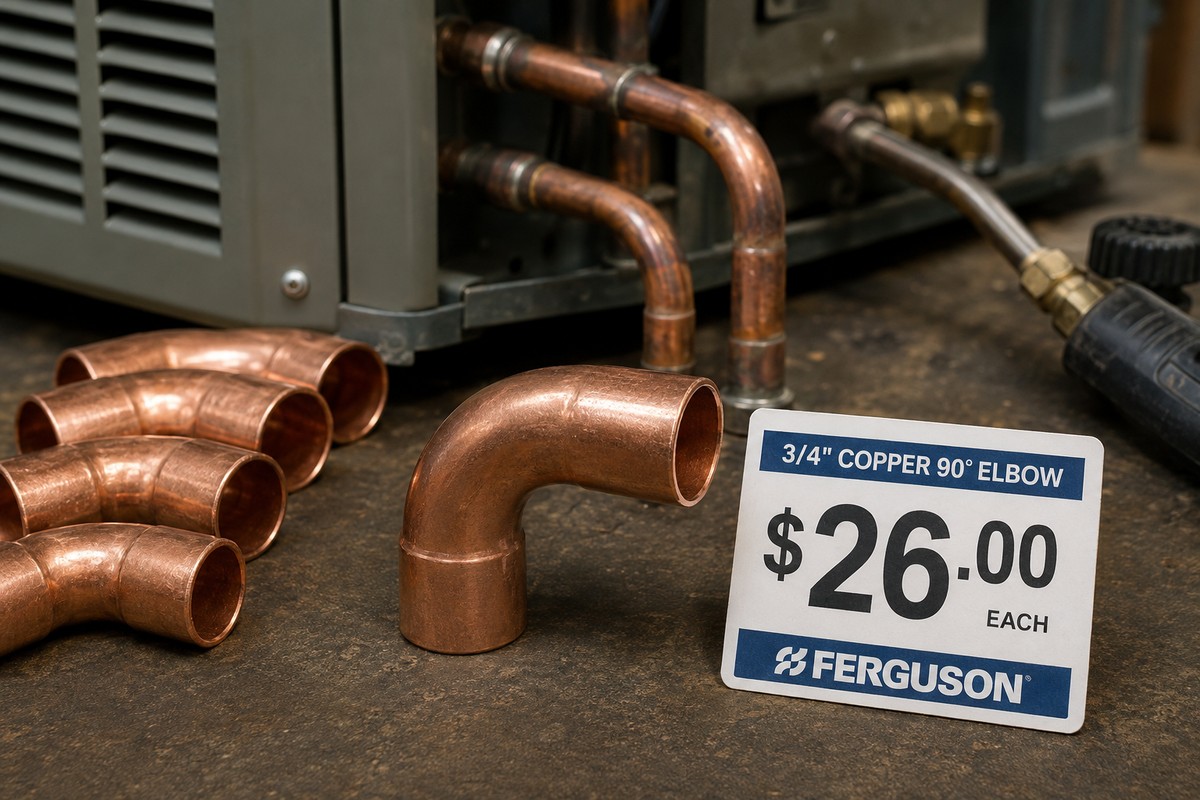
Yesterday, I went to Ferguson to purchase a simple fitting: a 3/4-inch copper 90-degree elbow.
This is not a complicated piece of equipment. It is simply a small piece of copper used to change the direction of a copper line.
I was quoted $26.00 for one elbow.
That caught my attention.
I remember a time when a copper elbow like this could be purchased for around a dollar.
From roughly $1 to $26 for one small copper fitting.
Whether you compare that historical price with the price I was quoted yesterday or compare today's prices among different suppliers, the lesson is the same:
The cost of the little things has changed dramatically.
And those little things are part of every HVAC installation.
Now Let's Put This Into an Air Conditioner Replacement
Here's where it gets interesting.
On one air conditioner replacement job I recently performed, I needed to modify the existing copper piping so it would properly connect to the new equipment.
The job required:
- Five 3/4-inch 90-degree copper elbows
- One 3/4-inch 45-degree copper elbow
- Copper tubing
- Brazing materials
- Labor to cut, fit, braze, and test the piping
Let's just look at the five 90-degree elbows.
At $26 each, five elbows cost:
5 × $26 = $130
That's $130 in fittings before I have even purchased the 45-degree elbow, the copper tubing, or any of the other materials required to complete the job.
And remember: these aren't optional decorative accessories.
They are necessary to make the new equipment connect properly to the existing system.
So Who Pays for That?
This brings me to a question that I think homeowners should understand:
Should the HVAC contractor simply absorb the cost?
Suppose I quote a customer a price to replace their air conditioner based on what I reasonably expect the job to require.
Then I arrive at the job and discover that the existing copper lines don't line up with the new equipment.
I have two choices.
I can tell the customer:
"The equipment doesn't fit the existing piping. That's going to be another $500."
Or I can decide to absorb the additional material and labor costs.
But if a contractor absorbs every unexpected cost, something eventually happens:
Those costs have to come from somewhere.
A business cannot continually purchase materials for $26 and charge the customer as though they cost $1.
The money has to come out of the contractor's profit.
And if the contractor consistently loses money on installations, eventually the business isn't going to be there to answer the phone.
The Homeowner Doesn't See the Elbow
This is one of the biggest disconnects between homeowners and contractors.
When a homeowner looks at a new air conditioner installation, they see the major components.
They see:
- The condenser
- The furnace or air handler
- The thermostat
- The copper refrigerant lines
What they don't see are all the little pieces that make the system fit together.
- Fittings
- Copper tubing
- Couplings
- Transitions
- Electrical components
- Disconnects
- Wire
- Brazing materials
- Nitrogen
- Refrigerant
- Drain materials
- Fasteners and sealants
Individually, many of these items don't look very expensive.
Together, they become a significant part of the cost of doing business.
And Then There Is Labor
The $26 elbow isn't really the most important part of the story.
The important part is what happens after the contractor buys it.
Someone has to measure the existing piping.
Someone has to determine how the new equipment needs to connect.
Someone has to cut the copper.
Someone has to clean and prepare it.
Someone has to fit the elbows and tubing.
Someone has to braze the connections.
Someone has to properly pressure-test the system.
Someone has to evacuate the system properly.
Someone has to commission the equipment.
The customer isn't paying $26 for an elbow. The customer is paying for a functioning air-conditioning system.
And that means paying for all of the material and skilled work required to create it.
Why Doesn't the New Equipment Just Fit?
That's another reasonable question.
Why can't the manufacturer simply make the new equipment fit the old system?
The problem is that homes and HVAC systems aren't built around one universal configuration.
Equipment changes. Manufacturers change. Models change.
Cabinet dimensions change. Connection locations change. Refrigerant requirements change. Building codes change.
And the system installed in your home may have been designed 10, 15, 20, or even 30 years ago.
The new equipment wasn't necessarily designed to drop into exactly the same space with exactly the same connections.
That's why an HVAC replacement isn't always a simple "take one out and put another one in" operation.
Sometimes the contractor has to adapt the new system to the old installation.
And that's where those $26 elbows come in.
Should the Contractor Eat the Cost?
Personally, I think this is an important conversation between contractors and customers.
A contractor should provide a fair and honest price. The customer deserves to know what they are paying for.
But a contractor shouldn't be expected to provide materials and skilled labor for free simply because the materials are small.
If I have to use five $26 elbows to properly adapt your existing copper piping to your new air conditioner, those elbows are part of the cost of installing your system.
I'm not charging you $130 because I want to make money on five little pieces of copper.
I'm charging for the actual materials and the work required to complete your installation.
There is an important distinction between charging a reasonable price for the work and simply adding unexplained costs to a customer's invoice.
Transparency matters.
The $26 Elbow Is a Small Example of a Much Bigger Problem
This is why I think homeowners need to look at HVAC replacement prices differently.
When you receive a quote for a new air conditioner, you're not just buying a piece of equipment.
Equipment + Materials + Skilled Labor + Tools + Transportation + Insurance + Licensing + Training + Warranty Support + Overhead
And buried inside all of that are dozens—or sometimes hundreds—of little decisions and little pieces of material.
The $26 copper elbow is just one example.
Five of them on one job is $130.
Add the 45-degree elbow. Add the copper. Add the other fittings. Add the labor. Add the equipment. Add everything else required to perform the installation correctly.
Suddenly, you begin to understand how the price of an HVAC replacement gets where it does.
The Question We Should Really Be Asking
Instead of asking only:
"Why does an air conditioner cost so much?"
Maybe we should also be asking:
"What does it actually take to replace one?"
Because the price isn't created by one expensive component.
It's created by hundreds of individual costs—some large, some surprisingly small—that have to come together to complete the job.
And sometimes, something as insignificant-looking as a little copper elbow tells the story better than anything else.
Yesterday, that little piece of copper cost me $26.
On one installation, I needed five of them. That's $130 before I even got started on the rest of the piping.
So the next time you look at an HVAC replacement estimate and wonder why the price is so high, remember:
You aren't just paying for the box sitting outside your house.
You're paying for everything it takes to make that box—and everything connected to it—work properly.
And sometimes, that includes a $26 copper elbow.