Updated: 2026-10-07
Furnace vs. Heat Pump: Which Is Better for a Utah Home?
Understanding furnaces, cold-climate heat pumps, dual-fuel systems, and the factors that matter in Utah
If you're replacing the heating and cooling system in your Utah home, there's a good chance you've heard more about heat pumps lately.
You may also have heard some very different opinions about them.
"Heat pumps don't work when it gets really cold."
"You don't need a furnace anymore."
"Heat pumps are always cheaper to operate."
"Gas heat is better for Utah."
There is some reasoning behind several of these statements, but none tells the whole story.
Heat-pump technology has changed significantly, particularly with the development of modern cold-climate systems. At the same time, Utah presents some important considerations: cold winter temperatures, homes with very different heating loads, different electric utility rate structures depending on location, and many properties that already have natural-gas furnaces.
So instead of asking:
Which is better—a furnace or a heat pump?
A better question may be:
Which heating system makes the most sense for my particular Utah home?
To answer that, it helps to understand what these systems actually do.
How Does a Gas Furnace Heat Your Home?
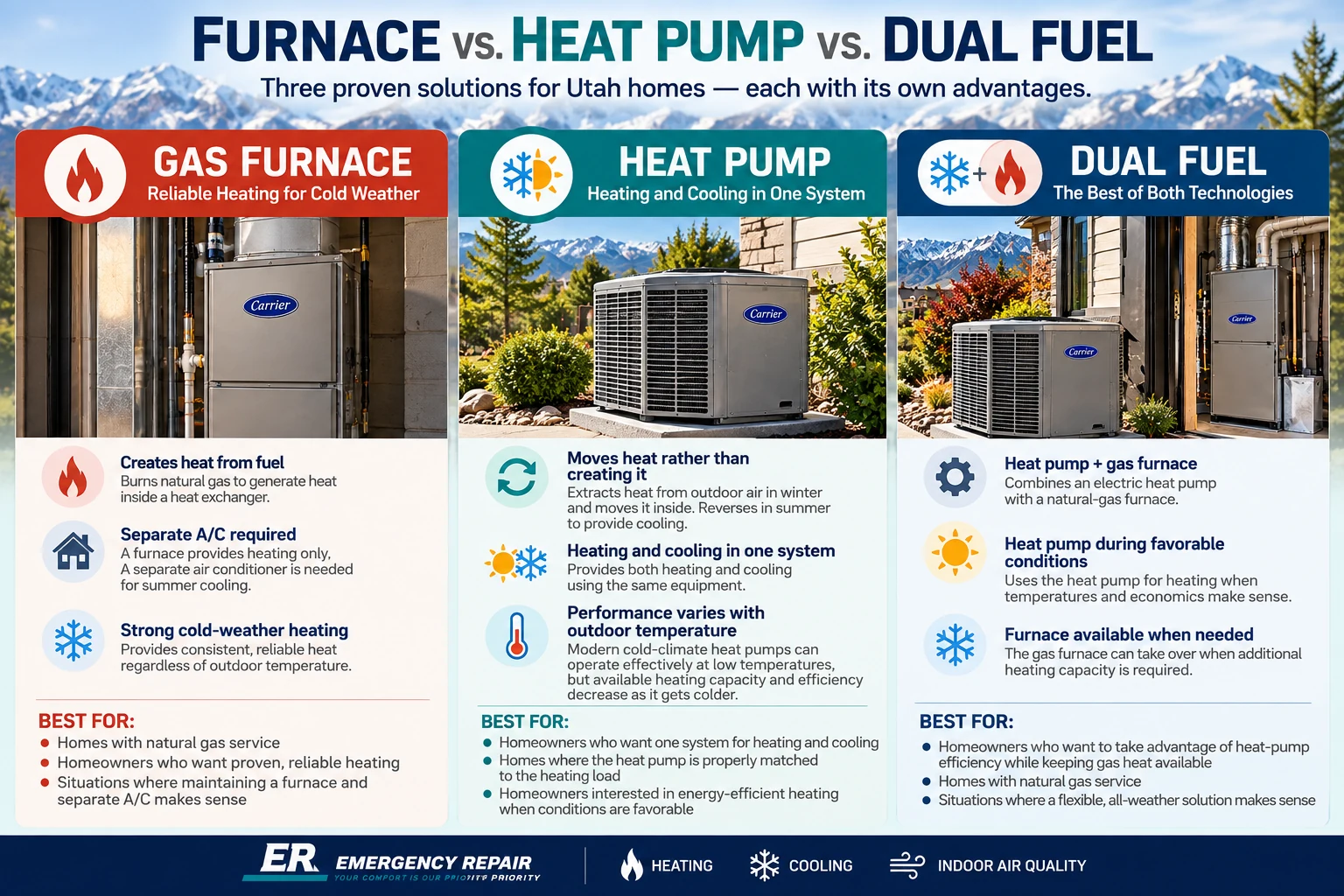
A gas furnace creates heat by burning fuel inside a heat exchanger.
The furnace blower moves household air across the heated heat exchanger and distributes that warmed air throughout the home through the duct system.
Modern high-efficiency furnaces can convert a very high percentage of the fuel they consume into usable heat, and their heating capacity isn't dependent on extracting heat from the outdoor air.
That's one reason furnaces have traditionally been so common in Utah.
But a furnace performs only the heating portion of the HVAC system. Most homes using a furnace still require a separate air-conditioning system for summer cooling.
How Is a Heat Pump Different?
Here's something that sometimes surprises homeowners:
A heat pump doesn't create heat the way a furnace does. It moves heat.
During summer, a heat pump operates much like a conventional air conditioner. It absorbs heat from inside the house and transfers that heat outdoors.
During winter, the refrigeration cycle reverses.
The system extracts heat energy from the outdoor air and transfers it into the home.
And yes—there is still heat energy available in outdoor air even when the temperature is below freezing.
The challenge is that as outdoor temperatures fall, the performance characteristics of the heat pump change. Depending on the equipment, available heating capacity and efficiency can decline as it gets colder.
Historically, that was one of the biggest limitations of air-source heat pumps in cold climates.
But that's also where some older assumptions about heat pumps need updating.
Modern Cold-Climate Heat Pumps Have Changed the Conversation
Today's cold-climate heat pumps are specifically designed to operate effectively at substantially lower outdoor temperatures than many older conventional heat pumps.
ENERGY STAR's cold-climate criteria, for example, require qualifying equipment to achieve a coefficient of performance (COP) of at least 1.75 at 5°F and provide at least 70% of its 47°F heating capacity at 5°F.
What does COP mean?
In simplified terms, a COP of 1.75 means the heat pump is delivering approximately 1.75 units of heat for each unit of electrical energy consumed under that test condition.
That matters here.
Salt Lake City's published building-design criteria list an 8°F winter design temperature and Climate Zone 5B.
That doesn't mean every Utah winter day reaches 8°F, and it certainly doesn't mean every heat pump is appropriate for every Salt Lake-area home.
It means that when selecting a heat pump here, we need to pay attention to what that particular equipment can actually produce at low outdoor temperatures.
The nominal tonnage printed on the equipment doesn't tell us the entire story.
Meet the “Balance Point”
This is one of the most useful heat-pump concepts for homeowners to understand.
As outdoor temperature drops, two things can happen at the same time:
The house needs more heat because heat is escaping from the building more rapidly.
Meanwhile, the heat pump's available heating capacity may decrease, depending on the equipment.
At some temperature, the home's heating requirement can exceed what the heat pump alone can provide.
That relationship is commonly described using the system's balance point.
Below that point, supplemental heating may be required to help satisfy the home's heating load.
This is why asking "At what temperature do heat pumps stop working?" isn't really the right question.
A better question is:
At what outdoor temperature can this particular heat pump no longer satisfy the heating requirement of this particular house by itself?
Those are two very different questions.
Building-science guidance similarly emphasizes comparing the home's calculated heating load with the heat pump's actual low-temperature performance rather than simply selecting equipment according to nominal capacity.
Auxiliary Heat and Emergency Heat Are Not the Same Thing
This is an area where terminology creates a lot of confusion.
You may see AUX HEAT or EMERGENCY HEAT on a heat-pump thermostat.
They don't necessarily mean the same thing.
Auxiliary heat is supplemental heating that the system can use when additional heating capacity is needed. Depending on how the system was designed, the supplemental source might be electric resistance heat or another heat source.
Emergency Heat, on the other hand, is generally a thermostat operating mode that relies on the backup heating source rather than normal heat-pump operation.
The backup system depends on how the HVAC installation was designed.
What About a Heat Pump AND a Furnace?
This brings us to an option that we think many Utah homeowners should at least understand:
Dual Fuel
A dual-fuel HVAC system combines an electric heat pump with a gas furnace.
Instead of asking the homeowner to choose exclusively between a furnace and a heat pump, the system can take advantage of both technologies.
During conditions where heat-pump operation makes sense, the heat pump provides heating.
When conditions reach the system's configured changeover strategy, the gas furnace can take over.
That changeover shouldn't simply be based on a number somebody guessed.
The heat pump's low-temperature performance, the home's heating requirement, equipment configuration, and energy costs can all affect where that transition makes sense.
For some Utah homes, this can provide a very interesting middle ground:
Heat-pump heating when appropriate.
Gas-furnace heating when appropriate.
Which One Costs Less to Operate?
This is probably where the comparison becomes most complicated.
And it's where we need to be careful about universal claims.
There isn't one electricity rate that applies to every homeowner along the Wasatch Front. Utah includes investor-owned and municipally owned electric utilities, and rate structures can differ by service territory.
So saying:
A heat pump always costs less to operate.
isn't particularly useful.
Neither is saying:
Natural gas will always be cheaper.
The actual comparison can depend on several factors: the homeowner's electricity rate, natural-gas cost, furnace efficiency, the heat pump's COP at different outdoor temperatures, the amount of auxiliary heat required, the home's heating load and, in a dual-fuel installation, the control strategy.
This is why equipment efficiency and operating cost are related, but they aren't exactly the same question.
A Higher Utility Bill Doesn't Automatically Mean Your HVAC Equipment Used More Energy
We recently encountered a good example of this in the field.
A homeowner was concerned because their electric bill had increased after installation of a new air-conditioning system.
Naturally, the new equipment became the first suspect.
But comparing only the dollar amount at the bottom of two utility bills doesn't tell us whether the HVAC equipment actually consumed more electricity.
A better comparison begins with:
How many kilowatt-hours did the home use?
Then we can look at other variables, including the energy rate, number of billing days, weather conditions, thermostat settings, and household usage.
The utility bill tells us how much that energy cost.
They are connected—but they're not the same measurement.
That's why homeowners investigating an unexpected utility bill should compare both usage and cost, rather than assuming the HVAC equipment is responsible simply because the dollar amount changed.
Proper Installation May Matter as Much as the Equipment You Choose
It's easy to spend all our time comparing equipment specifications.
But even excellent equipment can deliver disappointing results if the system isn't properly designed and installed.
When evaluating a heat pump, furnace, or dual-fuel system, we should consider the home's heating and cooling loads, insulation and air leakage, windows and construction, ductwork, outdoor design conditions, equipment capacity at those conditions, backup-heating strategy, and the homeowner's comfort expectations.
Proper system design includes performing appropriate load calculations and examining manufacturer extended-performance data at relevant design conditions rather than relying solely on the equipment's nominal size.
And simply installing a larger heat pump isn't necessarily the answer.
The system still needs to operate properly during cooling season and during the much milder portions of the heating season.
Good HVAC design is about matching the equipment to the building.
So Which System Is Better for a Utah Home?
There is no silver bullet.
Every home is different, and the best heating solution depends on the home, the equipment, the installation, local energy costs, and the homeowner's comfort expectations.
A gas furnace may be an excellent choice for a home that already has natural-gas infrastructure, where maintaining the existing furnace-and-AC configuration makes practical and economic sense, or where strong cold-weather heating capacity is particularly important.
A cold-climate heat pump may be an excellent choice when its low-temperature capacity is properly matched to the home's heating requirements and the homeowner wants one refrigeration-based system capable of both heating and cooling.
A dual-fuel system may be particularly attractive for homeowners who want to take advantage of heat-pump heating while retaining a gas furnace as an alternate heating source when conditions or economics favor it.
None of those systems automatically wins simply because of the technology involved.
Perhaps We're Asking the Wrong Question
Instead of asking:
Will a heat pump work in Utah?
we think homeowners should ask:
Will this particular heat pump perform well in my particular Utah home—and does it make sense compared with the alternatives?
Modern cold-climate heat pumps have changed what is technically possible in colder climates.
That doesn't mean every Utah homeowner should remove their gas furnace.
And it certainly doesn't mean heat pumps should be dismissed because of what older equipment could—or couldn't—do twenty years ago.
The right decision considers the home, equipment, climate, installation, energy costs, comfort expectations, and backup-heating strategy together.
Our Approach at Emergency Repair
At Emergency Repair, we believe homeowners should understand why a particular HVAC system is being recommended—not simply be told which piece of equipment to buy.
If you're considering replacing a furnace, air conditioner, or complete HVAC system, we can evaluate your existing equipment and discuss the available options, including traditional furnace-and-AC systems, heat pumps, and dual-fuel configurations.
Our objective isn't to sell every homeowner the same system.
It's to help determine which system makes the most sense for your home.
Considering a New Heating and Cooling System?
If you're comparing a gas furnace, heat pump, or dual-fuel system, Emergency Repair can help evaluate your home's existing equipment, heating and cooling needs, and available options.
We provide residential and commercial heating, cooling, refrigeration, and indoor air quality services throughout the Salt Lake City area and the Wasatch Front.
Emergency Repair
Your Comfort Is Our Business.
Phone:
385-484-8472
Website:
emergencyrepair.us